When Enterprise Support Starts Sounding Like Stalling

Challenge
In enterprise storage environments, customers can tell when a support case stops moving forward.
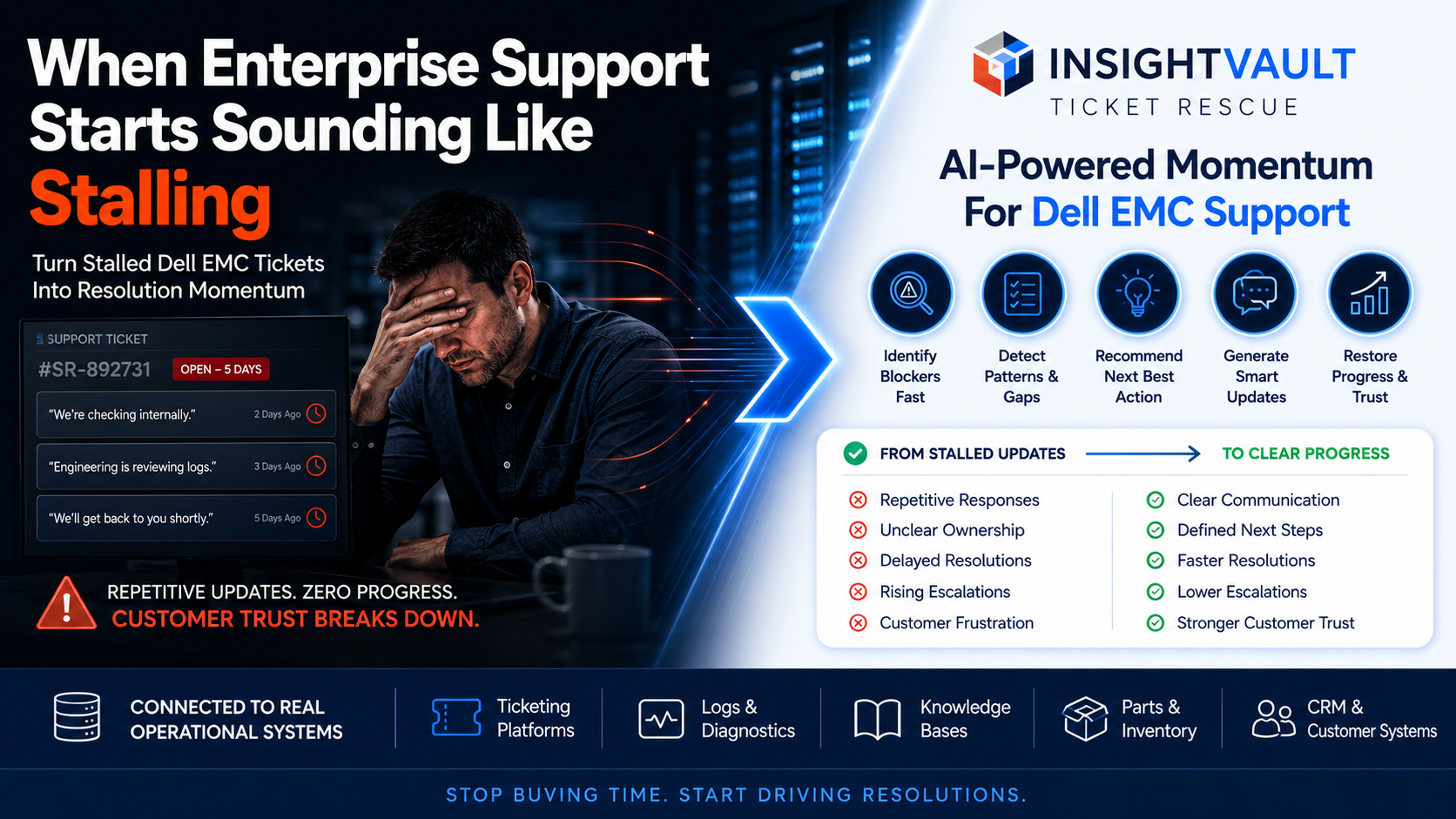
The updates keep coming, but nothing actually changes. “We’re checking internally.” “Engineering is reviewing logs.” “We’ll get back to you shortly.” After several days, those responses stop sounding reassuring and start sounding like delay tactics.
This happens often in complex Dell EMC storage workflows where root cause identification takes too long, ownership shifts between teams, and engineers are buried in fragmented diagnostics, incomplete notes, and repeated requests for the same information.
For customers, the frustration builds quickly. Infrastructure teams are already under pressure to restore stability, manage outages, and protect uptime commitments. When support interactions feel reactive or uncertain, trust starts breaking down.
Internally, support managers face escalating pressure. Engineers spend hours reviewing ticket history, searching for missing context, chasing diagnostics, and trying to determine what has already been attempted. Escalations increase because customers no longer believe the ticket is progressing.
The result is operational drag on both sides:
- delayed resolutions
- higher escalation volume
- exhausted engineering teams
- damaged customer confidence
- support interactions that feel like “buying time” instead of solving problems
Solution
InsightVault Ticket Rescue changes the experience from stalled support to visible operational momentum.
Instead of repetitive updates with little progress, support teams can quickly identify blockers, determine the next action, and communicate clearly with customers about what is actually happening.
Customers receive updates that explain:
- what has already been validated
- what issue patterns were detected
- what engineering action is happening next
- what data is still needed and why
This restores confidence because the interaction feels informed, structured, and proactive.
Support teams move faster because they spend less time manually reconstructing ticket history or searching through disconnected systems. Engineers can focus on solving the issue instead of repeatedly asking for logs, ownership clarification, or escalation details.
The result is:
- faster root cause identification
- fewer repetitive customer interactions
- reduced escalation pressure
- clearer ownership
- stronger customer trust during critical incidents
How It’s Done in InsightVault
A normal GPT tool can summarize a support conversation.
InsightVault Ticket Rescue goes much further because it works from real operational systems and active enterprise workflows.
Ticket Rescue is built specifically for stalled Dell EMC enterprise support cases where progress has slowed, communication is deteriorating, and resolution momentum is disappearing.
The platform:
- identifies likely blockers quickly
- separates signal from noise inside long ticket histories
- detects repeated requests and stalled workflows
- recommends the next operational action
- generates both customer-facing updates and internal rescue notes
- helps teams move tickets forward instead of recycling status messages
InsightVault connects directly with operational systems including:
- ticketing platforms
(ticket ownership, SLA status, escalation paths, queue history) - logs and diagnostics systems
(latest uploads, alerts, storage diagnostics, failure patterns) - knowledge bases
(Dell EMC procedures, known fixes, historical issue resolution data) - parts and inventory systems
(replacement workflows, dispatch readiness, hardware dependencies) - CRM and customer systems
(install base, entitlement, environment details, site information)
This matters because InsightVault works from real operational data — not just pasted chat context.
The platform continuously builds ticket intelligence from live support workflows so teams can:
- understand what is actually blocking progress
- reduce repeated customer requests
- communicate with confidence
- accelerate resolution momentum
Instead of sounding like support is “buying time,” teams sound prepared, informed, and in control.
